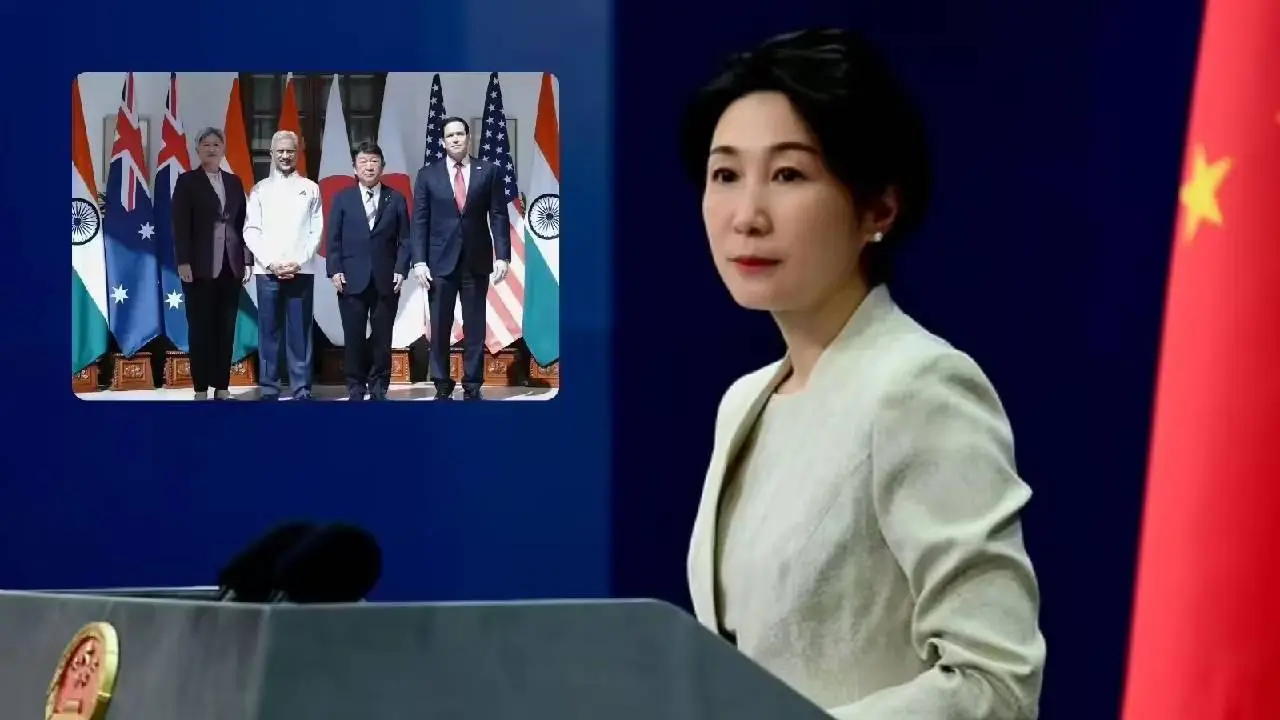
Beijing Reacts Sharply To QUAD’s New Maritime Strategy (Credit: OpenAI)
Beijing: China has reacted angrily to the latest QUAD meeting held in New Delhi, where member nations announced fresh maritime and strategic cooperation measures aimed at strengthening security across the Indo-Pacific region. Beijing accused the grouping of creating exclusive blocs and warned against targeting “third countries.”
Chinese Foreign Ministry spokesperson Mao Ning said on Tuesday that China has always opposed what it described as “small group politics” and military-style alliances directed against specific nations.
Reacting to QUAD’s newly announced maritime surveillance and port infrastructure initiatives, Mao Ning stated that cooperation between countries should promote regional peace and prosperity rather than create confrontation.
She said China does not support exclusive groups or bloc politics that weaken trust among regional countries. According to Beijing, any international cooperation should avoid targeting another nation directly.
China’s sharp response came after QUAD foreign ministers unveiled several new measures during their meeting in New Delhi. The initiatives focus on expanding maritime monitoring, strengthening port infrastructure and increasing cooperation in critical minerals and energy security.
The announcement comes amid rising concerns over China’s growing military presence and aggressive activities in the Indo-Pacific region, particularly in the South China Sea and East China Sea.
The high-level meeting was chaired by Indian External Affairs Minister S. Jaishankar and attended by US Secretary of State Marco Rubio, Australian Foreign Minister Penny Wong and Japanese Foreign Minister Toshimitsu Motegi.
In their joint statement, the ministers reaffirmed support for a “free and open Indo-Pacific” where countries can make independent choices without pressure or coercion.
Without naming China directly in several parts of the statement, QUAD leaders strongly criticized destabilizing and coercive actions in disputed maritime regions.
The ministers expressed serious concern over interference in offshore resource development, repeated obstruction of freedom of navigation and dangerous maneuvers involving military aircraft, coast guard ships and maritime militia vessels.
They also voiced concern over the militarization of disputed territories and called for maintaining peace and stability across the Indo-Pacific.
The QUAD nations also called for uninterrupted global trade through the Strait of Hormuz and criticized Iran’s actions involving commercial shipping in the region.
Analysts believe the meeting reflected growing strategic coordination among QUAD nations as they attempt to counter increasing geopolitical tensions and strengthen regional alliances.
China has long viewed QUAD as an anti-China strategic grouping designed to contain Beijing’s influence in Asia. Chinese officials frequently accuse the alliance of attempting to build an “Asian NATO.”
However, QUAD members continue to insist that the grouping is focused on maintaining regional stability, maritime security and economic resilience rather than targeting any single country. The latest exchange has once again highlighted the deepening geopolitical rivalry shaping the Indo-Pacific region.




Copyright © 2026 Top Indian News